If you have been living with depression or OCD and medication has not brought the relief you hoped for, or the side effects have made daily life harder rather than easier, you are not alone. This is exactly the gap that tDCS Therapy in Pune is beginning to fill. Transcranial direct current stimulation, or tDCS, is a gentle, non-invasive brain stimulation technique that works by adjusting the electrical activity in specific regions of the brain linked to mood and compulsive thinking. Unlike ECT, there is no anaesthesia, no memory disturbance and no hospital stay involved. For many patients in Pune who want an evidence-based option beyond pills, tDCS has quietly become worth a serious conversation with their psychiatrist.
What Is tDCS Therapy and How Does It Work?
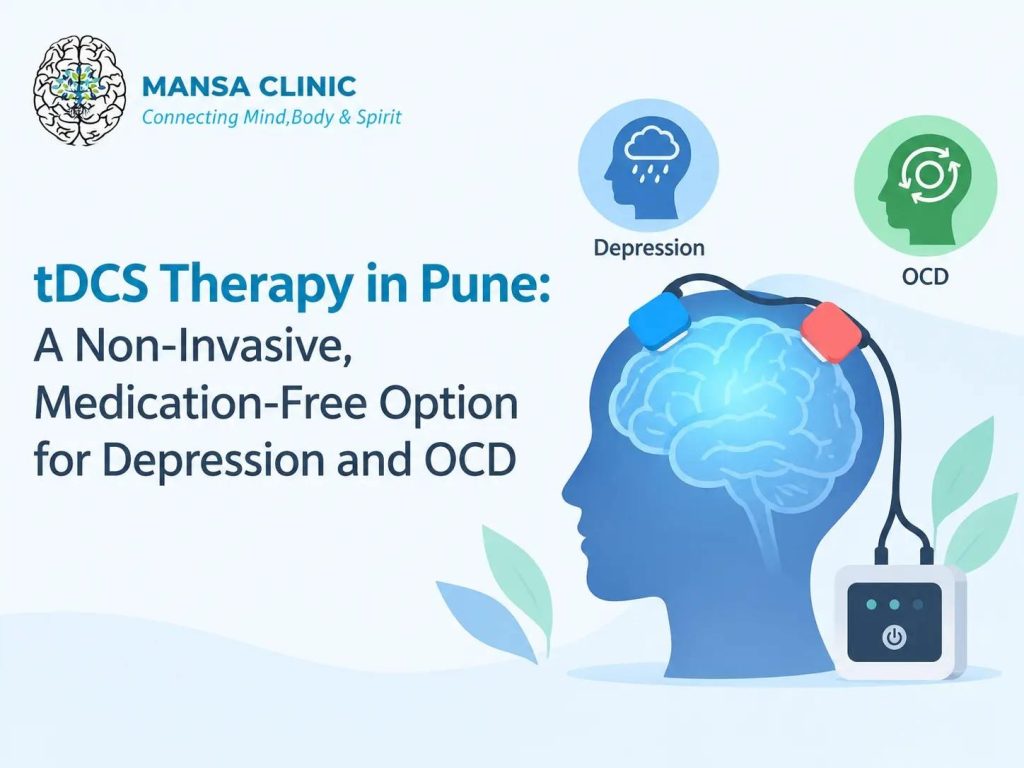
Transcranial direct current stimulation involves placing two small sponge electrodes on the scalp and passing a very mild, constant electrical current between them. The current is so low, usually between 1 and 2 milliamps, that most patients feel nothing more than a slight tingling or itching sensation at the start of the session. This is a far cry from the imagery people often associate with “electric shock treatment,” which actually refers to ECT, a completely different procedure that uses general anaesthesia and a much stronger current to induce a controlled seizure.
tDCS instead works on a subtler principle called neuromodulation. The weak current nudges the resting membrane potential of neurons in the targeted brain region, making them either slightly more or slightly less likely to fire. Over repeated sessions, this can shift the activity patterns of brain circuits that are known to function differently in people with depression and OCD, particularly the dorsolateral prefrontal cortex and the orbitofrontal-striatal network. The treatment does not force a specific outcome. It simply creates conditions in the brain that are more favourable for improvement, often alongside therapy and, where needed, medication.
How tDCS Helps in Depression
In depression, one of the most consistent findings in neuroimaging research is reduced activity in the left dorsolateral prefrontal cortex, a brain region tied to motivation, decision making and emotional regulation. tDCS protocols for depression typically place the anode, the positively charged electrode, over this exact region to increase its activity, while the cathode is positioned over the opposite side or a neutral site.
Patients often describe the shift not as sudden happiness but as a gradual lifting of mental heaviness. Concentration improves a little, decisions feel less exhausting and the pull toward negative thinking starts to loosen. This is usually not a one-session fix. Most protocols call for daily or near-daily sessions over several weeks, with the antidepressant effect building cumulatively rather than immediately. For patients whose depression has not responded fully to medication, or who cannot tolerate the side effects of antidepressants, this slow and steady mechanism can be an important addition to their care plan.
How tDCS Helps in OCD
OCD works differently in the brain compared to depression, and the electrode placement for OCD reflects that difference. Rather than the prefrontal cortex alone, treatment often targets circuits connecting the orbitofrontal cortex and the striatum, areas involved in the loop of intrusive thought and compulsive relief-seeking that defines OCD.
The idea here is not to erase intrusive thoughts. That is not how the brain, or OCD, works. Instead, tDCS aims to reduce the intensity of the urge to act on those thoughts, which can make exposure and response prevention therapy, the gold standard psychological treatment for OCD, more manageable for the patient. Many psychiatrists in Pune now use tDCS as a supportive layer alongside ERP rather than a replacement for it, since the combination tends to produce steadier results than either approach used in isolation.
Why tDCS Therapy in Pune Is Gaining Ground
Pune’s mental health landscape has shifted noticeably over the past decade. Long working hours in the city’s IT and business hubs, competitive academic pressure among students and the general erosion of joint family support systems have all played a part in rising rates of anxiety and depressive disorders across the city. At the same time, patients have become more informed and more willing to ask their psychiatrist about options beyond a prescription pad.
This is where a dedicated tDCS therapy program becomes relevant. Clinics offering tDCS Therapy in Pune are still relatively few, which means access to psychiatrist-supervised, correctly administered sessions matters a great deal. Self-administered or unsupervised tDCS devices sold online carry real risks, including incorrect electrode placement and inappropriate current dosage, neither of which a layperson is equipped to judge safely. A clinical setting with trained staff and a psychiatrist overseeing the protocol removes that guesswork entirely.
Patients dealing with OCD in particular benefit from being seen at a facility with a specialised OCD clinic, where tDCS sessions can be coordinated with ongoing ERP therapy rather than delivered as a standalone intervention.
What to Expect During a tDCS Session
A typical tDCS session lasts between 20 and 30 minutes. The process itself is fairly simple from the patient’s side.
- The psychiatrist or trained technician cleans the scalp at the electrode sites and applies a saline-soaked sponge under each electrode to ensure good conductivity.
- The electrodes are positioned according to the treatment protocol, which differs for depression and OCD.
- The current is switched on gradually and held at the prescribed intensity for the session duration.
- The patient can sit comfortably, read or simply rest during the session. There is no need for sedation.
- Once complete, the electrodes are removed and the patient can resume normal activities immediately.
A full course usually runs for two to six weeks, with sessions scheduled five days a week initially, followed by a tapering phase. This schedule mirrors what has been studied in clinical trials, since the antidepressant and anti-compulsive effects of tDCS tend to build with repetition rather than appearing after a single sitting.
Who Should Consider tDCS Therapy in Pune?
tDCS is generally considered for patients who fall into one or more of these categories.
- Those with moderate depression who have had a partial or unsatisfactory response to antidepressant medication
- Patients who experience troublesome side effects from psychiatric medication and want to explore non-drug options
- Individuals with OCD who need additional support alongside ERP therapy
- Patients who prefer to avoid or delay starting medication and want a gentler starting point
- People who are medically unfit for or hesitant about ECT but need more than talk therapy alone
That said, tDCS is not suitable for everyone. Patients with metal implants near the stimulation site, a history of seizures, or certain skin conditions on the scalp need a careful evaluation before starting. This is precisely why the treatment should only be undertaken under psychiatric supervision at adult psychiatric services rather than through an unsupervised home device.
tDCS Compared to Medication and ECT
It helps to see where tDCS sits relative to the two treatments patients usually already know about.
Medication works by altering neurotransmitter levels throughout the body and brain, which is why side effects like weight changes, drowsiness or sexual dysfunction are common. tDCS acts locally on specific brain circuits and generally produces a much milder side effect profile, most often limited to scalp tingling, mild redness or a brief headache.
ECT remains the most powerful option for severe, treatment-resistant depression, but it requires anaesthesia, a hospital setting and carries a risk of short-term memory disturbance. tDCS involves none of this. It is administered while the patient is fully awake and can be completed as an outpatient procedure, which makes it considerably easier to fit into a working professional’s schedule.
None of this means tDCS is a universal replacement for medication or ECT. Rather, it fills a specific middle ground for patients whose condition and preferences make it a reasonable fit, always as part of a plan designed by their treating psychiatrist.
Safety and Side Effects
tDCS has been studied in clinical settings for several decades and carries a favourable safety record when administered correctly. The most commonly reported effects are mild and temporary, including tingling or itching at the electrode site during the session, slight scalp redness that fades within a few hours and, occasionally, a mild headache or fatigue after the session. Serious adverse events are rare when the current intensity and electrode placement follow established clinical protocols, which is another reason why supervised administration at a proper clinic matters more than convenience or cost when choosing where to undergo treatment.
Conclusion
tDCS Therapy in Pune offers something that many patients with depression and OCD have been quietly looking for: a treatment path that does not begin and end with a prescription. It is non-invasive, requires no anaesthesia or hospital admission, carries a mild side effect profile and can be used alongside therapy or medication rather than instead of them. For patients who have struggled with medication side effects, or who want to explore every reasonable option before considering something more intensive, tDCS represents a genuinely useful addition to modern psychiatric care.
At Mansa Clinic, this treatment is overseen by Dr. Ninad Baste, MBBS, MD (Psychological Medicine) from Seth GS Medical College, Mumbai, who heads the clinic’s adult and geriatric psychiatry services. With over two decades of clinical experience, a term as President of the Indian Psychiatry Society, Pune Chapter, and a particular specialist interest in neurocognitive medicine, Dr. Baste brings the kind of careful, individualised assessment that a treatment like tDCS genuinely needs. If you are considering this option for yourself or a family member, book a consultation to discuss whether it is the right fit for your specific situation. You can also read more about the clinic’s approach and our specialist team before your first visit.
Frequently Asked Questions
Is tDCS therapy painful?
No. Most patients feel only a mild tingling or itching sensation at the electrode sites for the first minute or two of the session. There is no pain during or after treatment.
How many tDCS sessions are usually needed for depression or OCD?
Most protocols involve daily sessions for two to six weeks, though the exact number depends on the severity of symptoms and how the patient responds. Your psychiatrist will adjust the schedule based on progress.
Can tDCS be used alongside my current antidepressant or OCD medication?
Yes. tDCS is commonly used as an add-on treatment alongside medication and therapy rather than a replacement, particularly when the response to medication alone has been partial.
Is tDCS safe for long-term use?
When administered under psychiatric supervision with correct current intensity and electrode placement, tDCS has a well-established safety profile. Long-term studies have not shown evidence of lasting harm from properly conducted treatment.
Who should avoid tDCS therapy?
Patients with metal implants near the head, a history of seizures or certain scalp conditions should be evaluated carefully before starting. A psychiatric assessment beforehand helps rule out these concerns.
Does tDCS work immediately?
Not typically. Unlike a single dose of medication, the effects of tDCS tend to build gradually across a full course of sessions rather than appearing after just one sitting.

Dr. Ninad Baste
DR. NINAD BAST, MBBS MD [Psychological Medicine]
Affiliations: Maharashtra Medical Council [registration no.: 2003/03/1356], Pune Psychiatry Association, Indian Psychiatry Society, Bombay Psychiatry Society.
A desire to understand patients' needs in their illness phase and help them through it led Dr. Ninad to specialize in psychiatry after completing his MBBS. He earned his MD in psychological medicine from Mumbai's prestigious Seth GS Medical College. His special areas of interest are neurocognitive medicine, sexual medicine, marital counseling, and personal counseling.
He held the post of president of the Indian Psychological Society [IPS-Pune Chapter] for the year 2017–2018. Dr. Ninad was also a postgraduate guide and an associate professor at Smt. Kashibai Navale Medical College and a general hospital. He has worked on the editorial board of the Annals of Indian Psychiatry, which is the official journal of the IPS-West zone.
He has been a faculty member for various conferences and a member of the organizing committees of some conferences held in Pune.