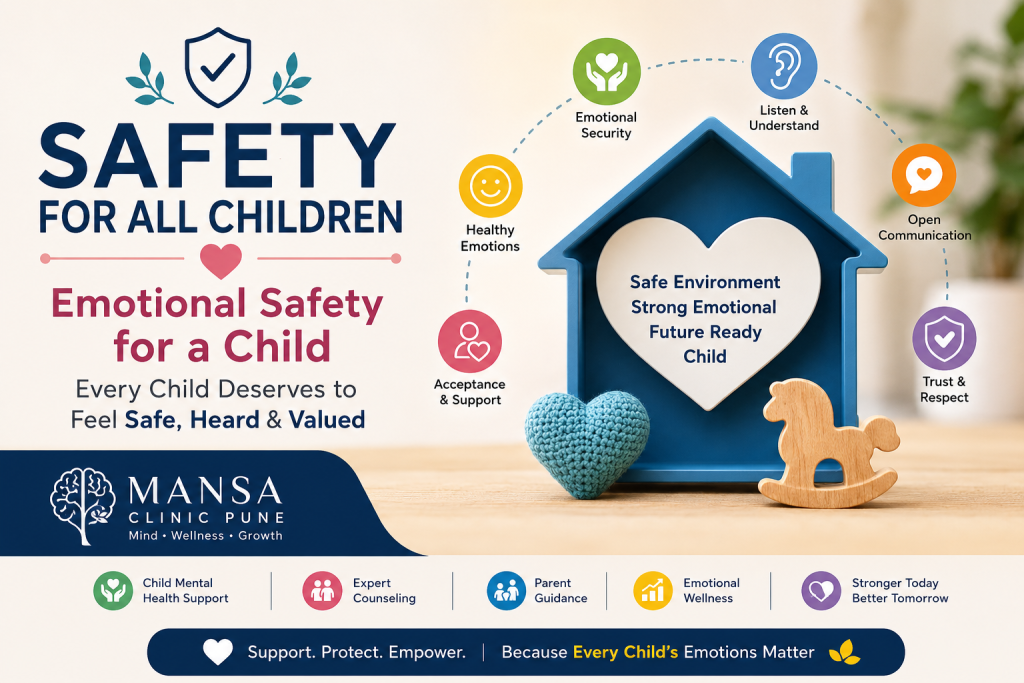
Children need more than food, education, and physical protection to grow into healthy adults. They also need emotional security. The idea of safety for all children includes creating an environment where children feel heard, respected, accepted, and loved without fear of shame, punishment, or rejection. Emotional safety forms the foundation of a child’s mental health, confidence, learning ability, and relationships.
Today, many children silently struggle with anxiety, fear, loneliness, academic stress, bullying, family conflicts, and emotional confusion. Some children express their emotions openly, while others hide their feelings. When emotional needs are ignored repeatedly, children may begin to believe that their emotions do not matter or that expressing feelings is unsafe. Experts in child mental health emphasize that emotionally safe environments help children become more resilient, confident, and emotionally stable adults.
At Mansa Clinic Pune, child emotional wellness and mental health support are important parts of care. The clinic focuses on helping children, adolescents, and families build emotional resilience and healthier communication through professional mental health guidance.
What Does “Emotional Safety for a Child” Mean?
Emotional safety for a child means creating an atmosphere where a child feels emotionally protected and accepted. It allows children to express feelings without fear of humiliation, anger, criticism, or rejection.
A child who feels emotionally safe can:
- Share feelings openly
- Ask questions without fear
- Admit mistakes honestly
- Seek help when upset
- Express sadness, fear, or anger safely
- Build trust with parents and caregivers
- Develop healthy self-esteem
Emotional safety does not mean allowing every behavior. Instead, it means correcting behavior without damaging the child’s confidence or emotional well-being.
Children who grow up in emotionally safe homes are more likely to develop emotional intelligence, healthy coping skills, and stronger social relationships.
Why Safety for All Children Is Important
Every child deserves to feel safe emotionally, mentally, and socially regardless of age, personality, gender, academic performance, or background.
When emotional safety is missing, children may develop:
- Anxiety
- Fear of failure
- Low self-confidence
- Social withdrawal
- Aggressive behavior
- Emotional suppression
- Difficulty trusting others
- Academic challenges
- Depression in later years
Repeated emotional invalidation can deeply affect a child’s self-image and emotional development. Children who are frequently ignored or criticized may begin to suppress emotions instead of understanding them.
Creating emotional safety for all children helps them:
- Feel secure
- Build resilience
- Handle stress better
- Learn healthy communication
- Improve emotional regulation
- Develop confidence
- Build positive relationships
Signs a Child Feels Emotionally Safe
Parents often wonder whether their child truly feels emotionally secure. Emotionally safe children may show several healthy behaviors.
1. They Share Problems Openly
Children who feel safe usually approach parents or caregivers when something goes wrong. They do not fear humiliation or harsh reactions.
2. They Express Emotions Freely
Emotionally safe children are comfortable expressing sadness, excitement, anger, or disappointment.
3. They Ask Difficult Questions
Children ask questions when they trust adults to respond calmly and respectfully.
4. They Return After Conflict
Emotionally secure children understand that disagreements do not end relationships.
5. They Show Their Real Personality
Children who feel emotionally safe do not constantly hide their feelings or personality traits.
Common Things That Damage Emotional Safety
Sometimes emotional harm happens unintentionally through daily communication patterns.
Constant Criticism
Frequent criticism can make children feel “not good enough.”
Comparing Children
Comparing siblings or classmates can damage confidence and increase insecurity.
Ignoring Emotions
When adults dismiss feelings with statements like:
- Stop crying
- You are too sensitive
- It’s not a big deal
children may learn to suppress emotions.
Harsh Punishments
Excessive punishment can create fear instead of understanding.
Lack of Listening
Children feel emotionally unsafe when adults constantly interrupt or dismiss them.
Emotional Unpredictability
Children need consistency. Sudden anger, shouting, or emotional instability at home can increase anxiety.
How Parents Can Create Emotional Safety for a Child
Creating emotional safety does not require perfection. Small daily habits can make a big difference.
Listen Without Immediate Judgment
Sometimes children simply want to feel heard.
Instead of saying:
- That’s silly
try:
- I understand that upset you.
Validation helps children trust their emotions.
Encourage Open Communication
Create regular opportunities for conversation:
- Family dinners
- Bedtime talks
- Car rides
- Weekend activities
Children often open up naturally during relaxed moments.
Stay Calm During Mistakes
Children learn emotional regulation from adults. Calm guidance is more effective than shouting.
Teach Emotional Vocabulary
Help children name emotions:
- Angry
- Nervous
- Disappointed
- Excited
- Lonely
- Frustrated
This improves emotional awareness.
Spend Quality Time
Even short periods of focused attention strengthen emotional security.
Apologize When Necessary
Parents are human. Apologizing teaches accountability and emotional honesty.
Support Without Overprotecting
Children need guidance, not control. Healthy independence builds confidence.
Emotional Safety at School
Schools also play a major role in safety for all children.
Emotionally safe schools encourage:
- Respectful communication
- Anti-bullying support
- Positive teacher-student relationships
- Inclusion
- Mental health awareness
Children who feel emotionally secure at school are more likely to:
- Participate in class
- Build friendships
- Improve academically
- Develop social confidence
Teachers and school counselors should recognize emotional distress early and support children compassionately.
Emotional Safety and Mental Health
Mental health begins in childhood. Emotional safety strongly influences long-term psychological well-being.
Children who experience emotional security are often better at:
- Managing stress
- Building healthy relationships
- Handling disappointment
- Solving problems
- Trusting others
On the other hand, emotional neglect may contribute to:
- Anxiety disorders
- Depression
- Behavioral challenges
- Emotional dysregulation
- Self-esteem issues
Professional mental health support can help children and families improve emotional communication and coping strategies.
Role of Professional Counseling for Children
Sometimes children need additional emotional support from trained professionals.
Child counseling may help when children experience:
- Anxiety
- School stress
- Anger issues
- Social withdrawal
- Behavioral concerns
- Trauma
- Family conflicts
- Emotional outbursts
- Bullying
- Academic pressure
Professional counseling provides a safe environment where children can express emotions in healthy ways.
Many child mental health professionals use:
- Play therapy
- Behavioral therapy
- Talk therapy
- Emotional regulation techniques
- Family counseling
- Parent guidance sessions
Child Emotional Wellness Support at Mansa Clinic Pune
Mansa Clinic Pune provides mental health and emotional wellness support for children, adolescents, and families. The clinic focuses on holistic emotional well-being and child mental health services.
The clinic’s approach includes:
- Emotional wellness programs
- Child and adolescent psychiatry support
- Counseling services
- Parent guidance
- Behavioral support
- Emotional development assistance
About Dr. Baste at Mansa Clinic Pune
At Mansa Clinic Pune, Dr. Baste and the team focus on psychological, emotional, and behavioral well-being through compassionate and evidence-based care. The clinic emphasizes emotional wellness, counseling, psychotherapy, and child mental health support to help families create emotionally healthier environments for children.
Emotional Safety in Different Age Groups
Toddlers
Young children need:
- Gentle responses
- Predictable routines
- Physical comfort
- Patience during tantrums
School-Age Children
Children in this age group benefit from:
- Encouragement
- Emotional discussions
- Positive discipline
- Social support
Teenagers
Teenagers need:
- Respectful communication
- Privacy
- Emotional validation
- Non-judgmental listening
- Mental health support during stress
Digital Safety and Emotional Well-Being
Modern children also face online emotional challenges:
- Cyberbullying
- Social comparison
- Screen addiction
- Online pressure
Parents should:
- Monitor digital behavior
- Encourage healthy screen habits
- Maintain open discussions about online experiences
Emotional safety today includes digital emotional protection as well.
Building Emotionally Safe Homes
Emotionally safe homes usually:
- Encourage honest conversations
- Avoid humiliation
- Support emotional expression
- Practice calm conflict resolution
- Focus on connection instead of fear
Children thrive when they feel accepted even during mistakes.
Long-Term Benefits of Emotional Safety
Children raised in emotionally safe environments often become adults who:
- Communicate effectively
- Maintain healthier relationships
- Handle stress better
- Trust themselves
- Have stronger emotional intelligence
- Show greater resilience
Emotional safety today shapes future emotional health.
When Should Parents Seek Professional Help?
Parents should consider professional mental health support if a child shows:
- Persistent sadness
- Severe anxiety
- Social withdrawal
- Sudden anger
- Sleep disturbances
- Self-esteem problems
- School refusal
- Aggressive behavior
- Emotional shutdown
- Major behavioral changes
Early intervention can improve emotional development and prevent long-term mental health difficulties.
Conclusion
Creating safety for all children begins with emotional understanding, compassionate communication, and supportive relationships. Every child deserves to feel emotionally secure at home, school, and within society.
Providing emotional safety for a child helps children grow into emotionally healthy, confident, and resilient adults. Small actions like listening carefully, validating emotions, and responding calmly can create a lifelong positive impact.
Professional emotional wellness support can also help families strengthen communication and emotional resilience. Mansa Clinic Pune focuses on child emotional wellness, counseling, and mental health care through compassionate and evidence-based approaches that support children and families in building healthier emotional foundations.
Book The free consultation for Your Childrens

Dr. Ninad Baste
DR. NINAD BAST, MBBS MD [Psychological Medicine]
Affiliations: Maharashtra Medical Council [registration no.: 2003/03/1356], Pune Psychiatry Association, Indian Psychiatry Society, Bombay Psychiatry Society.
A desire to understand patients' needs in their illness phase and help them through it led Dr. Ninad to specialize in psychiatry after completing his MBBS. He earned his MD in psychological medicine from Mumbai's prestigious Seth GS Medical College. His special areas of interest are neurocognitive medicine, sexual medicine, marital counseling, and personal counseling.
He held the post of president of the Indian Psychological Society [IPS-Pune Chapter] for the year 2017–2018. Dr. Ninad was also a postgraduate guide and an associate professor at Smt. Kashibai Navale Medical College and a general hospital. He has worked on the editorial board of the Annals of Indian Psychiatry, which is the official journal of the IPS-West zone.
He has been a faculty member for various conferences and a member of the organizing committees of some conferences held in Pune.