Table of contents
- Why More People in Pune Are Seeking Counselling Today
- What Happens Before Your First Appointment
- Walking Into That First Session: What It Actually Feels Like
- You Don’t Have to Have It All Figured Out
- Common Concerns People Raise in a First Session
- What the Counsellor Will (and Won’t) Do
- Different Types of Counselling You Might Encounter
- How Many Sessions Will You Need?
- Choosing the Right Counsellor in Pune
- Conclusion: Why Mental Health Counselling in Pune at Mansa Clinic Is Worth the Step
- Frequently Asked Questions
Deciding to reach out for help is never easy. For many people, the moment they finally search for mental health counselling in Pune, they have already spent weeks — sometimes months — quietly carrying something they couldn’t name. And then comes the next hurdle: not knowing what actually happens once you walk through a counsellor’s door. Will it be uncomfortable? Will you be judged? Will someone make you talk about things you aren’t ready to discuss? These are fair questions, and they deserve honest answers. This guide walks you through exactly what your first counselling session looks like, why those initial nerves are completely normal, and why taking that first step is always worth it.
Why More People in Pune Are Seeking Counselling Today
Pune has changed enormously over the last decade. The city’s rapid growth — especially in areas like Aundh, Baner, Wakad, and Kothrud — has brought professional opportunity, but it has also brought pressure. Long commutes, demanding work schedules, changing family dynamics, academic competition for students, and the lingering emotional weight of the pandemic years have pushed a growing number of people toward burnout, anxiety, and a quiet kind of sadness that doesn’t always have an obvious name.
According to the National Mental Health Survey of India, only 10–12% of people living with a mental health condition in urban areas ever actually receive professional care. That is a striking gap — and it exists not because people don’t want help, but because many simply don’t know where to start, or what to expect when they do.
The good news is that counselling today looks very different from the therapy scenes you may have seen in movies. It isn’t about lying on a couch and free-associating. It isn’t a process that requires you to have experienced a dramatic trauma. It is, at its core, a structured conversation with a trained professional who is there entirely for you.
What Happens Before Your First Appointment
Most people spend more time worrying about their first session than the session itself warrants. Before you arrive, here’s what you can generally expect from a reputable clinic:
A simple booking process. You don’t need a referral from your general physician. At most mental health clinics in Pune, you can call directly, use an online contact form, or even send a message to schedule. No lengthy paperwork just to get in the door.
A brief intake process. Many clinics will ask you to share a few basic details about what’s been bothering you — not to judge you, but to match you with the right clinician. If your concerns are primarily emotional and relational, you may be directed to a counsellor or psychologist. If your symptoms suggest something more clinical — persistent mood episodes, sleep disruption, or cognitive concerns — you might start with a psychiatrist.
Your privacy is protected. Everything you say in a counselling session is confidential. Your employer won’t find out. Family members won’t be told. You are in control of your own information.
Walking Into That First Session: What It Actually Feels Like
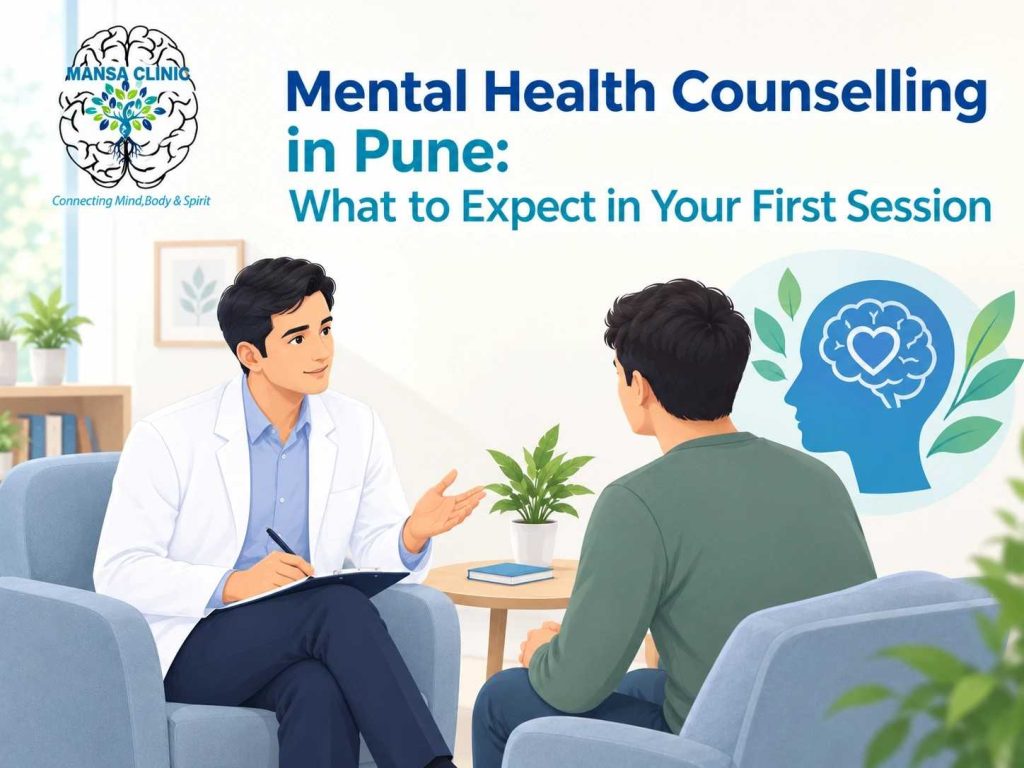
Most people describe their first session as feeling surprisingly normal. You sit across from a counsellor or therapist in a private, quiet room. There’s no clinical coldness to it — a good counsellor will work to make you feel as comfortable as possible before asking you anything significant.
The session typically begins with what professionals call an “intake” or “assessment conversation.” This isn’t an interrogation. It’s the counsellor’s way of understanding who you are, what’s been happening, and what you’re hoping to get from the process. You will be asked questions like:
- What brings you here today?
- How long have you been feeling this way?
- Has anything specific happened recently, or has this been building over time?
- How is this affecting your daily life — work, sleep, relationships?
You are never expected to have tidy, complete answers. Most people don’t. The counsellor’s job is to help you put shape to what might feel like a formless heaviness.
You Don’t Have to Have It All Figured Out
One of the biggest misconceptions about counselling is that you need to arrive with a clear problem to present. In reality, many people walk into their first session saying something like, “I don’t even know exactly what’s wrong — I just know something isn’t right.” That is a completely valid starting point.
A skilled counsellor is trained to work with ambiguity. They won’t rush you toward a label or a diagnosis in the first session. They are more interested in understanding your experience as a whole — your background, your relationships, your patterns of thinking — than in ticking boxes on a checklist.
What matters is that you showed up. The rest unfolds from there.
Common Concerns People Raise in a First Session
People come to counselling for a remarkably wide range of reasons. Some are dealing with something acute — a relationship breakdown, a bereavement, job loss, or a sudden panic attack that frightened them. Others are managing something chronic — a low-level anxiety that has followed them for years, difficulty sleeping, a persistent sense of emptiness, or trouble connecting with the people around them.
Here are some of the most common reasons people in Pune seek psychological counselling services:
- Stress and burnout — especially among IT professionals and those in demanding corporate roles
- Anxiety and worry — persistent, hard-to-switch-off thoughts that interfere with daily functioning
- Relationship difficulties — communication breakdowns, conflicts, or feelings of growing distance from a partner
- Low mood and depression — a persistent flatness, loss of interest in things once enjoyed, fatigue, or hopelessness
- Grief and loss — processing the death of a loved one, or the loss of a relationship or identity
- Life transitions — relocating to a new city, career changes, marriage, parenthood, or retirement
- Parenting concerns — parents worried about their child’s behaviour, emotional wellbeing, or development
There is no concern too small or too large to bring to a counselling session. If it’s affecting your quality of life, it’s worth talking about.
What the Counsellor Will (and Won’t) Do
There’s a common fear that a counsellor will simply tell you what to do, or worse, will spend the session silently judging your choices. Neither of these is what counselling is. A good counsellor does not give direct advice in the way a friend or parent might. They also won’t project their own values onto your situation.
What they will do is:
- Listen actively and without judgment
- Reflect back what they’re hearing to help you gain clarity
- Help you identify patterns of thought or behaviour that may be contributing to your distress
- Introduce frameworks, tools, or techniques — depending on the therapeutic approach they use — that can help you manage what you’re experiencing
- Collaborate with you on what you want to work on and at what pace
For some people, especially those dealing with symptoms that may have a clinical dimension — such as severe anxiety, mood disorders, or conditions requiring medication — a counsellor may work alongside a psychiatrist to provide coordinated care. At clinics that offer adult psychiatric services alongside counselling, this collaboration can happen seamlessly.
Different Types of Counselling You Might Encounter
Not all counselling is the same, and it helps to understand what different approaches involve:
Cognitive Behavioural Therapy (CBT): One of the most widely used and evidence-backed approaches. CBT focuses on identifying and changing thought patterns that are driving unhelpful emotions and behaviours. It’s particularly effective for anxiety, depression, and OCD.
Psychodynamic Counselling: This approach explores how past experiences and unconscious patterns are shaping your present behaviour and emotional responses. It tends to be more exploratory and less structured than CBT.
Emotion-Focused Therapy (EFT): Often used in couples or marital counselling, EFT helps individuals and partners understand the emotional needs driving their behaviour and rebuild secure emotional connections.
Art Therapy: A creative, non-verbal approach that uses artistic expression to process emotions that may be difficult to articulate in words. Particularly useful for children and individuals who find traditional talk therapy challenging.
EMDR (Eye Movement Desensitisation and Reprocessing): A specialised technique used for trauma processing, now backed by a strong evidence base.
Your counsellor will discuss the most appropriate approach for your situation. You won’t be expected to have preferences or prior knowledge — they will guide you.
How Many Sessions Will You Need?
This is one of the most common questions people ask, and the honest answer is: it depends. Some people find that four to six focused sessions help them significantly. Others work with a counsellor over several months as they navigate deeper or more complex concerns.
What most counsellors will tell you is that the first session is exploratory — it’s about building a relationship and understanding the picture. By the second or third session, you’ll typically have a clearer sense of whether the fit feels right and what the shape of the work ahead looks like.
It’s also worth knowing that progress in counselling is rarely linear. There will be sessions that feel difficult or uncomfortable — and that’s often a sign that important work is happening.
Choosing the Right Counsellor in Pune
Not every counsellor is the right fit for every person, and that’s completely normal. When evaluating your options, consider:
- Qualifications and training: Look for counsellors who hold recognised degrees in psychology, counselling, or a related field, and who are trained in specific therapeutic modalities.
- Supervised experience: A counsellor who has been trained under clinical supervision — particularly within a hospital or specialist clinic setting — brings a depth of practice that matters.
- Specialisation: If you’re dealing with a specific concern — trauma, relationship difficulties, addiction, or a child’s emotional needs — a counsellor with specific training in that area will serve you better.
- The relationship: Ultimately, research consistently shows that the quality of the therapeutic relationship is one of the strongest predictors of positive outcomes. You should feel heard, respected, and safe. If you don’t, it’s okay to say so or to look elsewhere.
You can also meet the team at Mansa Clinic to understand each counsellor’s background, training, and areas of focus before booking your appointment.
Conclusion: Why Mental Health Counselling in Pune at Mansa Clinic Is Worth the Step
If you’ve read this far, something in you is already leaning toward reaching out. That instinct is worth trusting.
Mental health counselling in Pune is no longer a niche service available only to those in crisis. It is an accessible, evidence-based form of professional support that helps real people navigate the real pressures of modern life — and at Mansa Clinic in Aundh, Pune, that support is built on a foundation of genuine clinical depth.
Here’s what you gain when you choose Mansa Clinic:
- Psychiatrist-led oversight — every patient’s care is anchored by Dr. Ninad Baste (MBBS, MD – Psychological Medicine, former President of the Indian Psychiatry Society, Pune Chapter) or Dr. Vidya Ganapathy (MBBS, DPM, MD – Psychological Medicine, NIMHANS-trained child psychiatrist), with over 23 combined years of specialist experience
- A multidisciplinary team — psychologists, counsellors trained in CBT, EMDR, EFT, and trauma therapy, an art therapist, and a physiotherapist working together under one roof
- Child and adolescent specialist care — with a NIMHANS-trained child psychiatrist and a Comdeall-certified autism therapist on staff
- Advanced therapeutic options — including tDCS (transcranial direct current stimulation), a non-invasive brain stimulation therapy for depression, OCD, and cognitive rehabilitation
- Culturally aware care — a team that understands Pune’s family structures, professional pressures, and language preferences
- Complete confidentiality — a clinic designed for privacy, where no information is shared without your explicit consent
- Neighbourhood convenience — located at Parihar Chowk, Aundh, easily accessible from Baner, Wakad, Kothrud, and PCMC
You don’t need to wait until things feel unbearable. Book your first appointment at Mansa Clinic today and take the step that thousands of families in Pune already have.
Frequently Asked Questions
Q1. Is my first counselling session confidential?
Yes, completely. Everything discussed in a counselling session at Mansa Clinic is governed by strict medical confidentiality. Your information is not shared with your employer, family members, or any third party without your explicit written consent — except in very rare, legally defined safety situations.
Q2. Do I need a referral from a doctor to book a counselling session?
No referral is required. You can book directly by calling Mansa Clinic or using the contact form on their website. Most people self-refer after deciding they want support.
Q3. What is the difference between a counsellor and a psychiatrist?
A psychiatrist is a medical doctor who has completed a postgraduate degree in psychological medicine. They can diagnose mental health conditions and prescribe medication where needed. A counsellor or psychologist provides talk-based therapy. At Mansa Clinic, both work together — the psychiatrist provides clinical oversight while counsellors lead the therapeutic work.
Q4. How long does a typical counselling session last?
Most individual counselling sessions last between 45 and 60 minutes. The first session may run slightly longer as it includes a broader intake conversation.
Q5. Is online / telecounselling available?
It is worth checking directly with Mansa Clinic about current online session availability, as this has expanded significantly post-pandemic. Call the clinic or use the contact form to confirm options.
Q6. What should I bring to my first counselling session?
There’s no formal preparation required. If you have any previous psychological assessments, medical reports, or notes from a previous therapist, it can be helpful to bring those. Otherwise, simply come as you are — your counsellor will guide the session.
Q7. Can counselling help with anxiety without medication?
Yes. For many individuals, particularly those with mild to moderate anxiety, talk therapy — especially CBT — is highly effective on its own. For more severe presentations, a combination of medication (managed by a psychiatrist) and counselling often produces the best outcomes. Your care plan at Mansa Clinic will be personalised to your specific needs.

Dr. Ninad Baste
DR. NINAD BAST, MBBS MD [Psychological Medicine]
Affiliations: Maharashtra Medical Council [registration no.: 2003/03/1356], Pune Psychiatry Association, Indian Psychiatry Society, Bombay Psychiatry Society.
A desire to understand patients' needs in their illness phase and help them through it led Dr. Ninad to specialize in psychiatry after completing his MBBS. He earned his MD in psychological medicine from Mumbai's prestigious Seth GS Medical College. His special areas of interest are neurocognitive medicine, sexual medicine, marital counseling, and personal counseling.
He held the post of president of the Indian Psychological Society [IPS-Pune Chapter] for the year 2017–2018. Dr. Ninad was also a postgraduate guide and an associate professor at Smt. Kashibai Navale Medical College and a general hospital. He has worked on the editorial board of the Annals of Indian Psychiatry, which is the official journal of the IPS-West zone.
He has been a faculty member for various conferences and a member of the organizing committees of some conferences held in Pune.